
Legal transcriptions generally avoid em dashes and ellipses, instead relying on double dashes, sometimes referred to as reporter’s dashes.
space dash dash space--
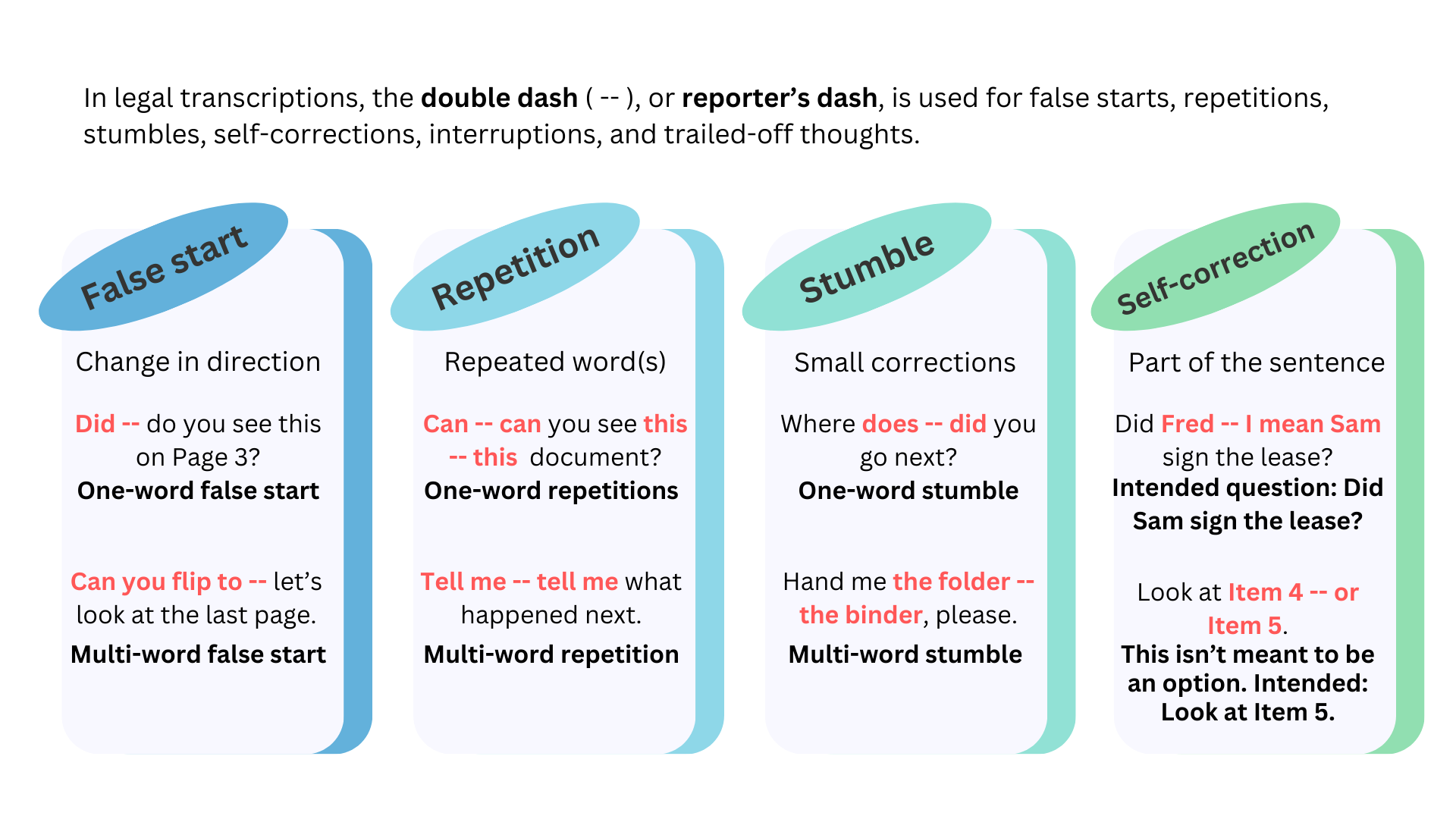
Double dashes are used to avoid excessive commas, particularly in the case of verbatim transcripts where every word (or nearly every word) needs to be preserved. The goal is to improve readability by offsetting false starts, indicating interruptions in speech or changes in direction, and separating repetitions.
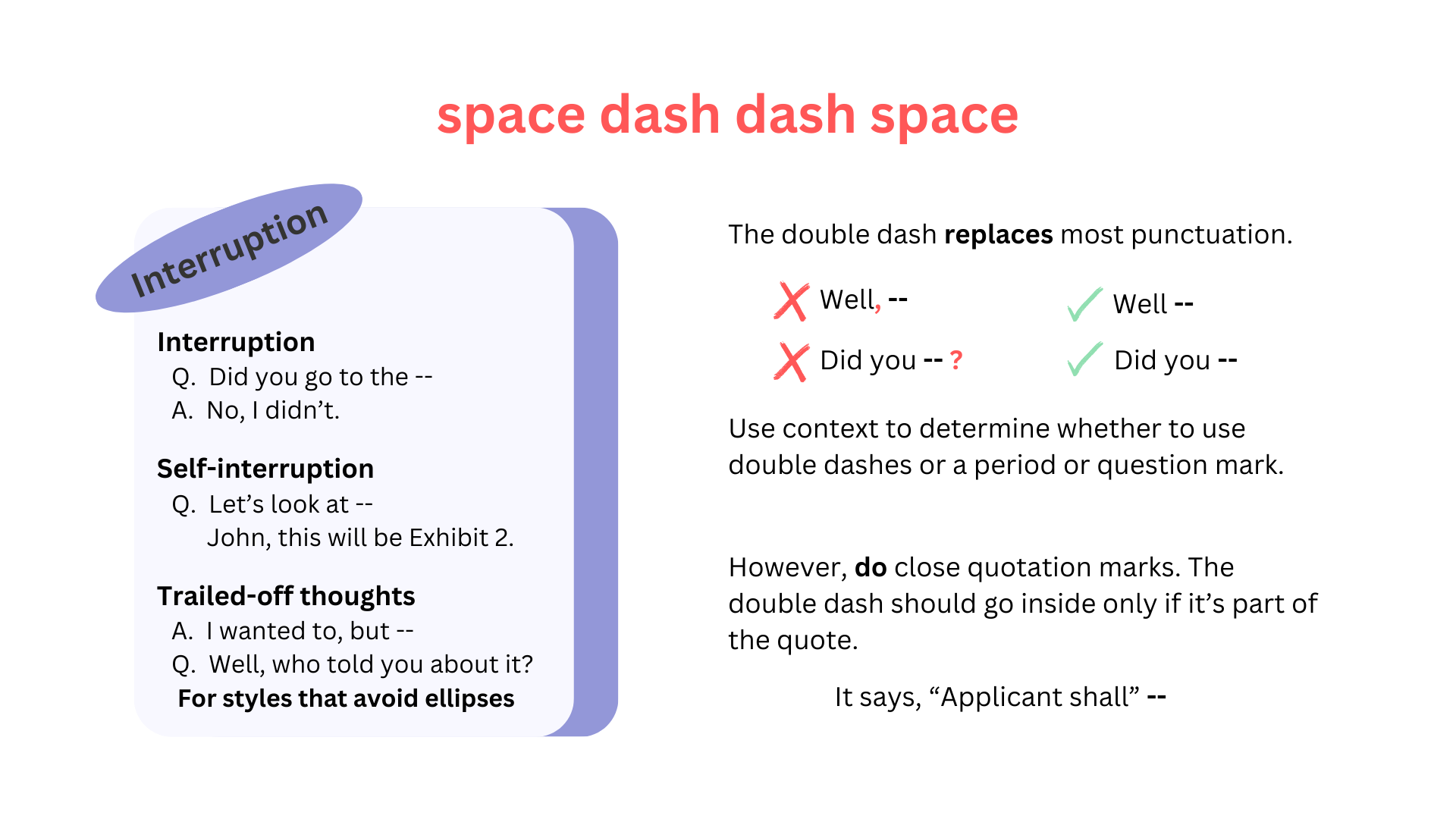
❗ Note: a single space always comes between the word(s) and the double dashes for most legal transcription styles.
Check your client’s style guide carefully! Some do allow ellipses for trailed off thoughts. Fewer still will have a preference for no space between the first dash, instead ending like this-- with no space before and one after, though this is rare.
False Starts
Use a double dash to separate every false start, even when there are multiple at a time:
➡️ Did -- do you -- can you see this?
*Some clients prefer to remove one-word false starts and some prefer to remove all false starts, while others will keep everything.
Repetition
When one or more words are repeated, use a double dash.
➡️ I -- I -- I cannot see the screen.
➡️ Where did you -- where did you see the defendant?
*Again, always check your client’s style guide carefully. Many clients prefer to keep just 2 instances of the repeated word(s).
❗However, use a comma for repetition that is intended for emphasis:
➡️ I really, really couldn't see anything. It was very, very dark.
More examples of when to use double dashes coming soon!
❗ When working in Word, make sure that auto-formatting of double hyphens to an em dash is turned off.
– File > Options > Proofing > AutoCorrect Options > AutoFormat tab
– Under Replace, uncheck “Hyphens (–) with dash (—)”
(For standard legal transcriptions, all of these options should be unchecked.)
❓ Why the double dash? It’s a holdover from the days of the typewriter, and legal formatting has changed very little since that time.